Equality Impact Assessments
Practical in-house Equality Impact Assessment training. Help staff assess policies and decisions, identify equality impacts and develop effective actions.
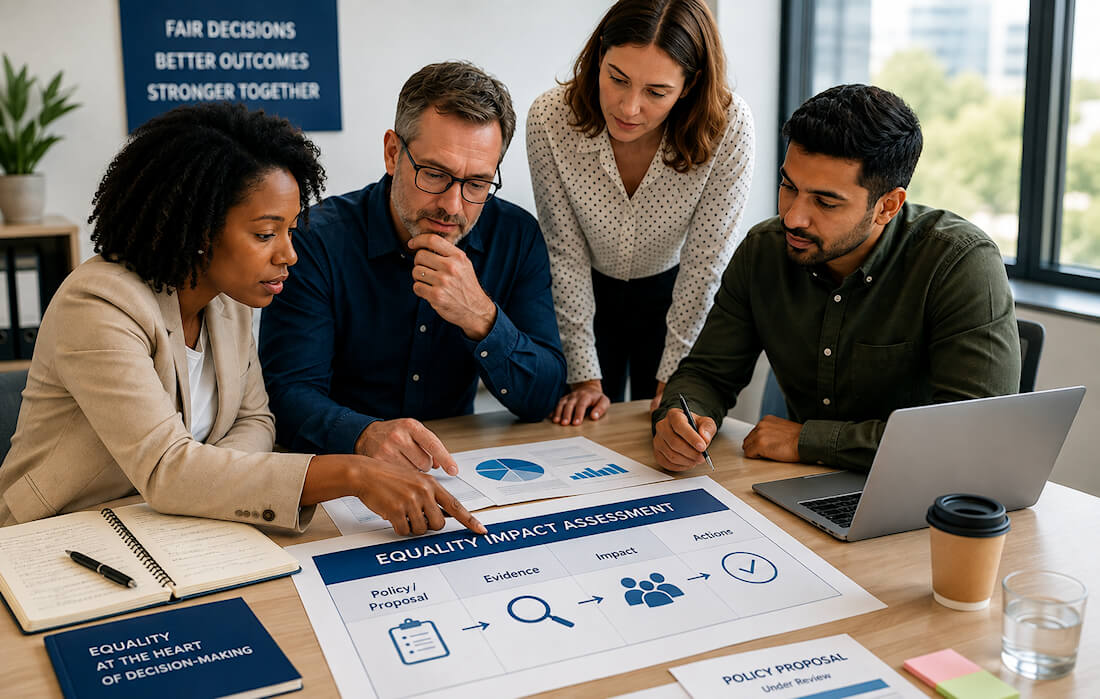
Practical in-house Equality Impact Assessment training. Help staff assess policies and decisions, identify equality impacts and develop effective actions.
Equality Impact Assessments provide a structured way to consider how policies, decisions, services and organisational changes may affect different people. Done well, they help organisations identify potential disadvantage, use evidence more effectively and build equality considerations into decision-making from the outset.
In‑house courses are private sessions delivered exclusively for a group of people from your organisation, on a date that suits you, with the option to tailor the content to your staff and setting.
Open courses are public Equality and Diversity UK training dates that anyone can book onto, ideal when you only need training for one or two people.
Equality Impact Assessments, sometimes referred to as Equality Analysis, help organisations examine the potential equality implications of their policies, practices, services and decisions.
Rather than treating equality as something to consider after a decision has been made, an effective EIA encourages organisations to consider who may be affected, what evidence is available, whether different groups could experience different outcomes and what action may be needed.
This practical course takes delegates through the Equality Impact Assessment process step by step. It explores the purpose of an EIA, the questions that should be asked, the evidence that can inform an assessment and how findings can be translated into meaningful action.
The programme is designed to make the EIA process practical and understandable, giving delegates the confidence to apply it to real organisational policies, services, projects and decisions.
Policies and decisions that appear neutral can sometimes affect groups of people differently. These effects may not always be obvious when a policy or service is first designed.
Equality Impact Assessments create an opportunity to identify those potential effects before decisions are finalised, helping organisations make better-informed and more transparent decisions.
Consider who may be affected by a policy, service, decision or organisational change and where different impacts could arise.
Use data, research, consultation and other evidence to understand how different people may experience the proposal.
Identify practical actions to reduce disadvantage, address concerns and strengthen positive equality outcomes.
This course is suitable for anyone involved in developing, reviewing, approving or implementing policies, services, projects or organisational decisions.
It is particularly useful for:
No previous experience of completing an Equality Impact Assessment is required.
The course takes delegates through a structured EIA process, helping them understand not only what information should be recorded but why each stage matters.
Clarify what is being proposed, why it is being introduced and whether a fuller equality assessment is required.
Identify the purpose of the assessment, the people who may be affected and the equality issues that need to be explored.
Consider what quantitative and qualitative evidence is available, what it tells you and where important gaps remain.
Identify whose experiences and perspectives should inform the assessment and how meaningful engagement can strengthen the evidence.
Assess potential positive, negative and neutral impacts and consider whether particular groups may experience disadvantage.
Identify proportionate actions to address concerns, reduce negative impacts and strengthen positive equality outcomes.
Record decisions, monitor the impact of actions, review the assessment when circumstances change and communicate the outcome appropriately.
An EIA should tell the story of the decision: what was considered, what evidence was used, whose experiences were taken into account, what potential impacts were identified and what action followed.
The course places Equality Impact Assessments within the wider context of equality legislation and organisational responsibilities.
Delegates explore relevant principles of the Equality Act 2010, including protected characteristics, discrimination and the role of the Public Sector Equality Duty where this applies to their organisation or work.
Consider how policies and decisions may affect people across the protected characteristics and where different experiences or outcomes may arise.
Understand how apparently neutral policies or practices can sometimes create disadvantage and why potential equality impacts need careful consideration.
Explore how structured equality analysis can support organisations in demonstrating thoughtful and evidence-informed decision-making.
A meaningful Equality Impact Assessment should be informed by evidence rather than assumptions about how people may be affected.
Delegates consider different sources of evidence and how these can be used together to build a clearer picture of potential impact.
A lack of data does not necessarily mean there is no equality impact. Delegates explore how to identify evidence gaps, avoid unsupported assumptions and decide what further information or engagement may be needed.
Data alone may not explain how a policy or decision will be experienced in practice. Consultation can provide important insight into barriers, unintended consequences and issues that may otherwise be overlooked.
The course considers who should be involved, when engagement should take place and how organisations can use consultation as meaningful evidence rather than simply as a procedural exercise.
Identify the employees, service users, communities, representative groups or other stakeholders whose perspectives may be relevant.
Engage early enough for people's experiences and evidence to genuinely influence the proposal or decision.
Choose accessible and proportionate methods that enable relevant stakeholders to contribute meaningfully.
One of the most important parts of an EIA is moving from information gathering to analysis.
Delegates explore how to consider whether a proposal could create positive, negative or neutral impacts and whether those effects may be different for particular groups.
Where could the proposal improve access, participation, opportunity or outcomes for particular groups?
Could the proposal create or increase disadvantage, barriers or unequal outcomes for particular people or groups?
Is there evidence that the proposal is unlikely to create a significant differential equality impact?
Identifying an equality impact is only useful if the organisation considers what should happen next.
Where potential disadvantage is identified, delegates explore how to consider alternatives, adjustments and proportionate actions. Where positive impacts are identified, the EIA can also help organisations consider how these benefits might be strengthened.
The purpose of an Equality Impact Assessment is not simply to complete a document. Its value comes from the thinking, evidence, engagement and action that inform the decision.
This is a practical course. Delegates have opportunities to apply the EIA process rather than simply hearing about it.
For in-house delivery, exercises can be based on your organisation's own policies, services, projects or proposed changes. This enables delegates to practise asking the right questions using examples that are directly relevant to their work.
Where appropriate, delegates can bring an existing policy, proposal or Equality Impact Assessment to the session so that learning can be applied to a real organisational example.
By the end of the course, delegates should be better able to:
Every organisation uses Equality Impact Assessments differently. We can tailor the programme to reflect your own EIA process, documentation, policies and organisational responsibilities.
Where possible, we can incorporate examples from your organisation so that delegates practise applying the process to situations they are likely to encounter in their work.
If your organisation already has an Equality Impact Assessment template or guidance, this can be incorporated into the training so that delegates develop their skills using the process they will apply after the course.
All our in-house courses are tailored to ensure the training reflects your organisation's goals and priorities.
The course can be delivered face to face or online via Zoom or Teams.
Equality Impact Assessments is primarily a full-day course. This allows sufficient time to explore the EIA process in depth, work through practical examples and give delegates the opportunity to apply their learning.
A shortened half-day version can also be delivered where required. This provides a more focused introduction to the key principles and stages of Equality Impact Assessment but allows less time for detailed practical application.
We charge £895 for the full-day course.
A shortened half-day version is available from £595. Please note that half-day delivery may not always be available for face-to-face training.
We can tailor Equality Impact Assessment training around your organisation's policies, EIA documentation and decision-making processes, helping staff develop the confidence to move from completing forms to carrying out meaningful equality analysis.
Discuss Your Training RequirementsOver 25 years' experience delivering equality, diversity and inclusion training, consultancy and professional development.
Enter your email address and we'll send full details.