Unconscious Bias Open Course
Explore how unconscious bias and assumptions influence decisions, interactions and opportunities, with practical strategies for fairer, more inclusive choices.
 >
>
Explore how unconscious bias and assumptions influence decisions, interactions and opportunities, with practical strategies for fairer, more inclusive choices.
>
Unconscious bias can influence our judgements, interactions and decisions without us necessarily recognising that it is happening. This practical and non-judgemental open course helps delegates understand how bias develops, recognise where assumptions may influence workplace decisions and develop practical approaches for making fairer and more considered choices.
Open courses are public Equality and Diversity UK training dates that anyone can book onto, ideal when you only need training for one or two people.
In‑house courses are private sessions delivered exclusively for a group of people from your organisation, on a date that suits you, with the option to tailor the content to your staff and setting.
We all make rapid judgements. Our brains constantly process large amounts of information and use previous experiences, patterns and associations to help us interpret the world around us.
These processes can be useful, but they can also contribute to assumptions about people and situations. When those assumptions influence workplace decisions or behaviour without being examined, they can contribute to unfairness, exclusion and inequality.
This course provides a clear and non-judgemental introduction to unconscious bias. Rather than suggesting that people can simply eliminate bias, delegates explore how to become more aware of potential influences on their judgement and how practical safeguards can support fairer decisions and more inclusive behaviour.
Unconscious or unintentional bias can influence how we interpret people, situations and information. Assumptions may relate to race, disability, sex, age, sexual orientation, religion or belief, as well as many other aspects of a person's identity, background or experience.
In the workplace, these assumptions can potentially influence recruitment, progression, performance decisions, leadership, professional relationships and access to opportunities. They can also affect how people experience an organisation as employees, customers, patients or service users.
Understanding unconscious bias therefore matters not because we can divide people into those who are “biased” and those who are not, but because greater awareness can help us recognise where assumptions may be influencing judgement and introduce more considered approaches to decision-making.
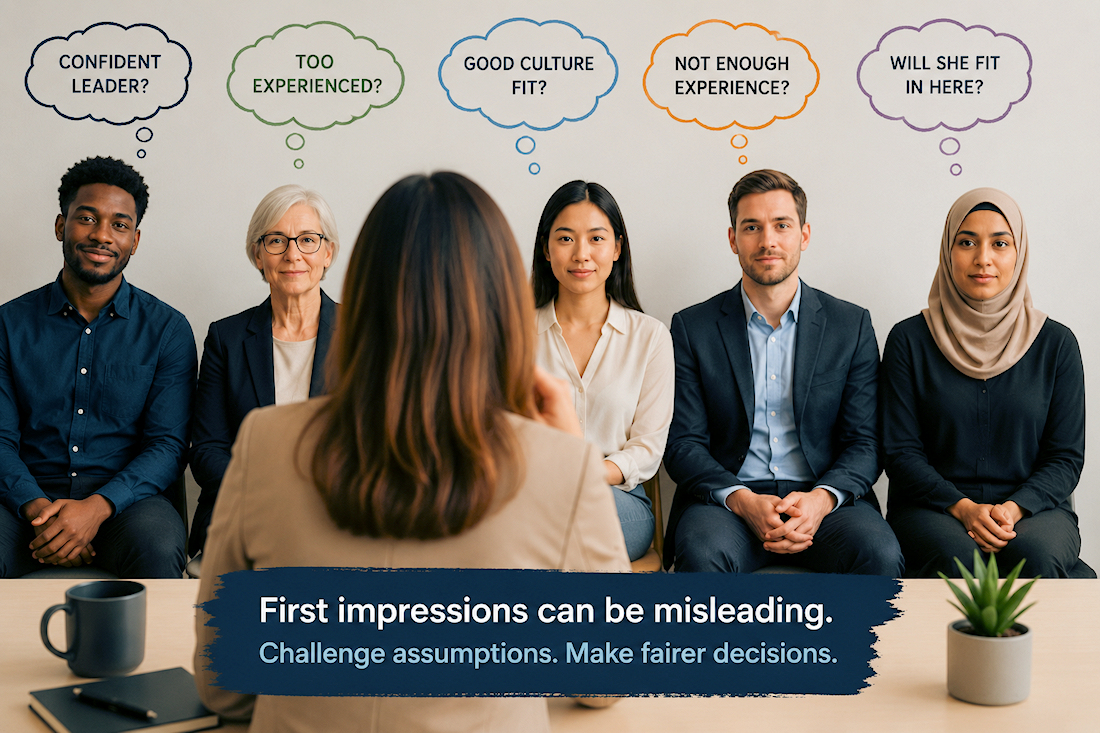
The aim is not to eliminate every automatic thought or assumption. It is to develop the awareness and practical strategies needed to question first impressions, check the evidence and make fairer, more inclusive decisions.
Bias does not always appear as deliberate or obviously discriminatory behaviour. It may influence seemingly ordinary judgements about who appears capable, trustworthy, suitable, professional or a good “fit”.
Past experiences, stereotypes and learned associations can influence what we expect from other people before we have considered all the available information.
Those assumptions may affect how we interpret behaviour, assess performance, evaluate potential or make decisions about opportunities.
When unchecked assumptions repeatedly influence decisions, they can contribute to unequal experiences and reinforce existing patterns of disadvantage.
Awareness is useful, but awareness alone does not guarantee fair decisions. The course therefore focuses on practical ways of interrupting assumptions and introducing more considered approaches to judgement and decision-making.
Become more alert to assumptions, patterns of thinking and situations in which bias may be more likely to influence judgement.
Create space between an initial impression and a decision, giving yourself an opportunity to question the evidence behind your judgement.
Use clear criteria, evidence, alternative perspectives and structured processes to support fairer and more consistent decisions.
During the course, delegates consider how bias and assumptions may influence different aspects of organisational life, including:
The course may use the Implicit Association Test (IAT) as one of a number of reflective activities to help delegates explore automatic associations and consider how our thinking can be influenced by experiences and learned patterns.
The IAT is used as a prompt for reflection and discussion rather than as a diagnostic assessment of an individual or a definitive measure of whether somebody is “biased”.
This is a participative open course and delegates are encouraged to contribute their experiences and perspectives within a respectful learning environment.
Activities can include:
By the end of the course, delegates should be better able to:
This open course is suitable for people working at all levels who want to understand unconscious bias and develop more considered approaches to workplace decisions and interactions.
It is particularly useful for:
No previous unconscious bias or EDI training is required.
This is a practical and interactive live course. Delegates are encouraged to participate in discussions, exercises and reflective activities throughout the day.
The course is delivered live online via Zoom.
This allows delegates to participate from anywhere while still benefiting from a facilitated group learning experience with people from different organisations and sectors.
The course runs from 10.00 am to 3.30 pm.
The course fee is £395 per delegate.
If you need to train a team or would like examples and activities tailored to your organisation, our in-house Unconscious Bias training may be more suitable.
View In-House Unconscious Bias TrainingOver 25 years' experience delivering equality, diversity and inclusion training, consultancy and professional development.
Enter your email address and we'll send full details.